


The Kalahari Copper Belt is a rapidly emerging copper-silver mining region renowned for high-grade, sediment-hosted deposits, attracting growing global attention and investment amid rising demand for copper.
Several advanced and operating projects are already established, including Sandfire’s Motheo Mine and the high-grade Khoemacau Copper-Silver Mine, acquired by MMG in 2024 for US $1.9 billion. Emerging developments include Cobre’s Ngami and Kitlanya projects, with BHP recently investing US$25 million in the Kitlanya joint venture.
Galileo’s ground is proximal to all these discoveries and shares a similar structural and stratigraphic setting, placing us in an excellent position for discovery.
The Kalahari Copperbelt continues to attract new companies and investment, resulting in an evolving understanding of mineralisation across the region. We are very excited about our recent developments and the fact that we have encountered copper mineralisation over an extensive interval in our first reconnaissance drilling programme is very encouraging. The combination of position and prospectivity provides us with strong motivation to continue exploration on this licence.
Colin Bird, Executive Chairman
Galileo Resources
Geology & Mineralisation
Copper mineralisation within the belt is sediment hosted and structurally controlled, with many discoveries associated with the redox contact between the D’Kar and Ngwako Pan lithological units. The region is structurally complex, and the presence of tight, upright folding creates potential mineral trap sites conducive to the formation of larger deposits. These traps are often bounded by regional shear-zones that facilitate fluid flow.
Portfolio
The project comprises three priority licences, licence PL253/2018 is wholly owned by Galileo and PL’s 039/2018 & 040/2018 are under agreement with Sandfire Resources following their sale in 2026.
PL253/2018 (wholly owned by Galileo)
Strategically situated between Cobre’s Ngami and Kitlanya West projects. Recent reconnaissance drilling returned encouraging results, including a 49 metre anomalous copper interval from 66m downhole in drillhole QTRC014 and peak grades of 0.84% Cu. The licence contains several additional untested copper-in-soil targets contiguous with anomalies defined on the neighbouring Cobre licences, and further positive indicators include the identification of tightly folded and thrust-repeated inclusions of the prospective D’Kar/Ngwako Pan contact.
PL039/2018 & PL040/2018
Located south of the Khoemacau Mine, close to recent discoveries along the Mowana Fold structure. These licences were sold to Sandfire Resources in 2026 to advance exploration and development. The agreement includes a future success payment of between US$20 million and US$80 million, payable should a qualifying copper reserve be established.
Galileo has carried out extensive exploration across our ground, including Terraleach™ soil sampling, geophysical and airborne surveys, and drilling, identifying multiple priority targets with geological characteristics consistent with major deposits across the belt.
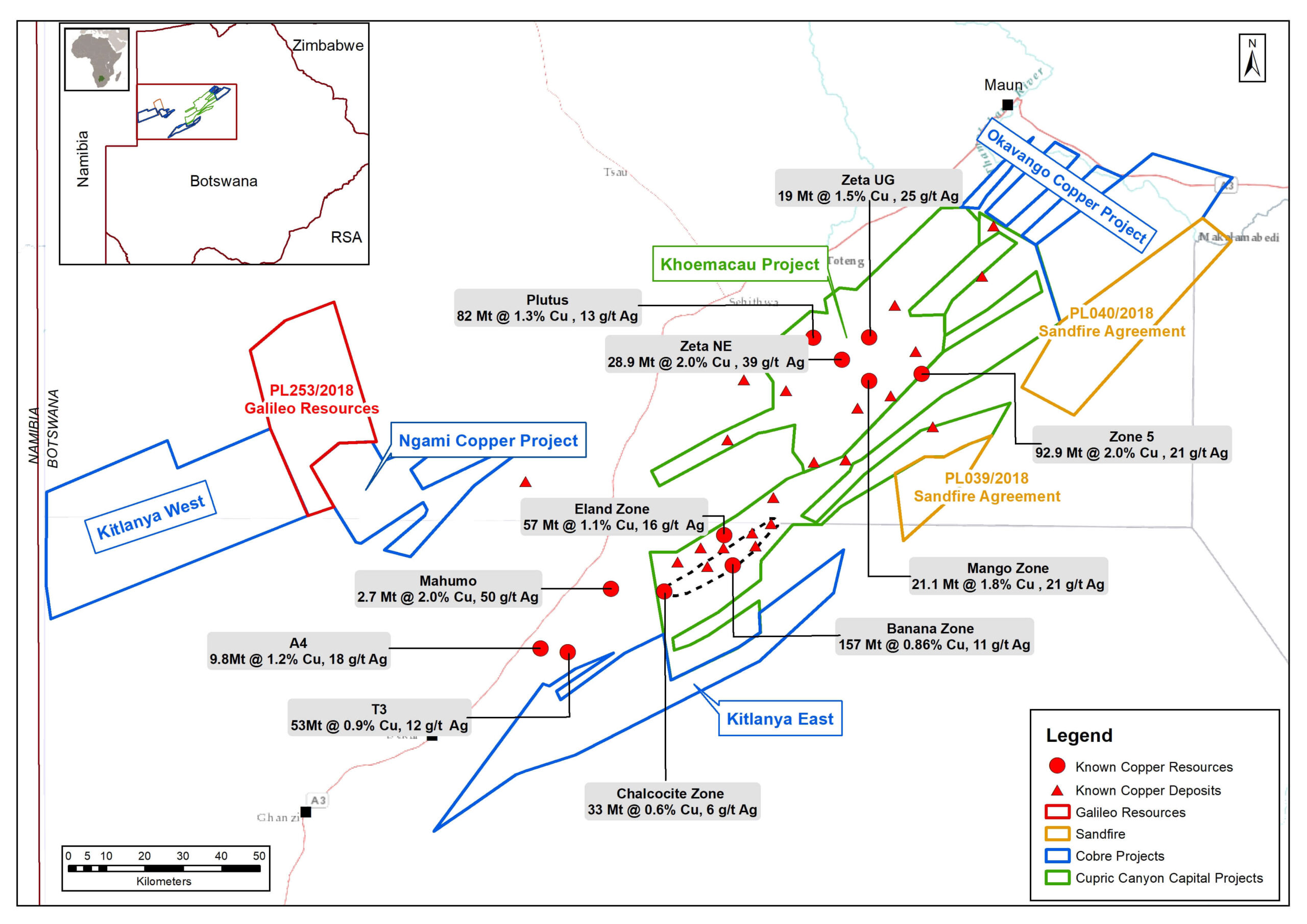
Galileo project location map
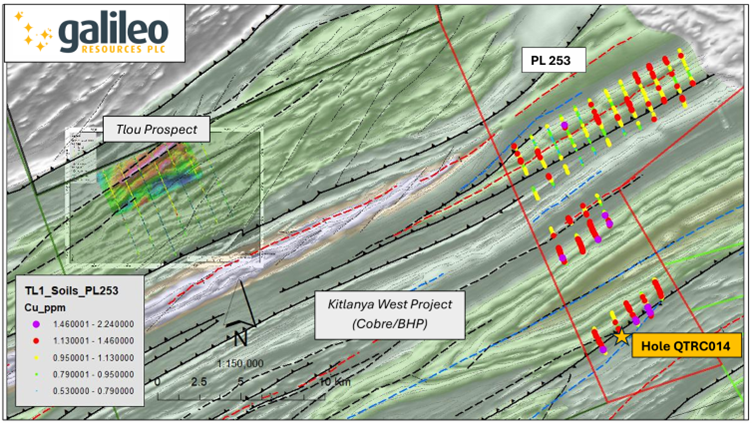
Location of recent drill intercept on PL253